Towards a Relational Green Social Work
Gregor Husi
Lucerne University of Applied Sciences and Arts (HSLU), Switzerland
CORRESPONDENCE:
Gregor Husi
e-mail: gregor.husi@hslu.ch
Abstract
The environmental crisis, especially the climate crisis, is becoming increasingly acute – with all the social and cultural consequences that entails. Social work is becoming aware of this, and a number of concepts for ecologically oriented social work are now available. What has been lacking so far is a theoretically sound conception of social work that links ecological thinking with relational thinking. Lena Dominelli’s green social work offers excellent opportunities for this. Its most important theorems are presented at the beginning. Her approach implies relationality, but its theoretical elaboration is largely lacking. The aim of this article is to close this gap. To this end, the discourses of relational social work and relational sociology are examined. As far as the latter is concerned, Pierre Bourdieu, Anthony Giddens and Jürgen Habermas deserve special attention. However, what these three social theorists have in common is that they have hardly addressed the relationship between society and nature. This deficiency can be remedied with the help of social and political ecology. Important concepts here are societal relations with nature and the imperial mode of living. Against this broad discursive background, relational green social work — known in German-speaking countries as «Grüne Soziale Arbeit» — can finally be presented as a new, theoretically ambitious approach to future social work.
Keywords
Keywords: Relational social work, Relational sociology, Green social work, Imperial mode of living, Relationality.
Introduction
The world is constantly changing. Social work must therefore be open to new perspectives in order to continue to fulfil its tasks even better. Ecological thinking on the one hand and relational thinking on the other open up such new perspectives. Both ways of thinking seem to be central to future social work, and initial concepts for them have been around in social work for some time. Traditional social work, however, still finds this rather difficult.
In the following discussion, both approaches will be systematically brought together. Lena Dominelli’s green social work is particularly striking; its key tenets are outlined at the outset. These, however, call for a relational clarification. To this end, relevant discourses are examined and, whilst remaining closely tied to the text, theoretical outlines of the most important components are provided. This ultimately leads to «Relational Green Social Work». This term was chosen for the English-speaking world in order to highlight, alongside all the commonalities, what clearly distinguishes this theoretical approach from Dominelli’s pioneering work. (The German term for this is «Grüne Soziale Arbeit».)
Green social work
Social work has been dealing with issues relating to the (natural) environment for quite some time, particularly in English-speaking countries. Several approaches have emerged, each with its own designation (for an overview, see Närhi & Matthies, 2016, p. 13f.; Ramsay & Boddy, 2017, p. 70). Among these, Lena Dominelli’s approach stands out. The British author has coined an apt and catchy term for it: green social work. Dominelli (2019a, p. 234) sees the difference between this and other approaches such as ecological social work or environmental social work in the following points:
- holistic approach
- political analysis
- critique of capitalism
- power relations, social inequality
A relational perspective shines through in these distinctive features: «It emphasises interdependencies between people, plants, animals and planet earth» (Dominelli, 2019a, p. 233). «Green social work (GSW) is a transdisciplinary, holistic approach to environmental crises» and should be integrated «into daily, routine, mainstream practice» (Dominelli, 2018, p. 9). Dominelli describes her understanding in more detail as follows: «I define «green» social work as that part of practice that intervenes to protect the environment and enhance people’s well-being by integrating the interdependencies between people and their socio-cultural, economic and physical environments, and among peoples within an egalitarian frame-work that addresses prevailing structural inequalities and unequal distribution of power and resources» (Dominelli, 2012, p. 8).
The definition in a summary article is similar. Here, Dominelli (2019a, p. 233) wants social workers to «include environmental justice as an integral part of their existing preoccupations with social justice». Her approach «centres social justice within a duty to care for and about all living things, animate and inanimate» (Dominelli, 2019a, p. 233). She understands «environmental justice» to mean «the right to live in a healthy environment» (Dominelli, 2013, p. 436). Dominelli follows in the tradition of egalitarianism, which also means «redistributing social resources more equitably across the world» (Dominelli, 2002, p. 35), especially with regard to children and women. The talk of interdependencies suggests a relational understanding. It is a holistic, comprehensive approach. And this approach is transdisciplinary (Dominelli, 2018, p. 17).
Dominelli (2013, p. 431) calls for a comprehensive «greening of the profession», focusing on intervention in natural disasters (2009) and clearly placing green social work in the traditional triad of case work, group work and community work, specifically in the latter: «Green social work is a form of community social work that addresses both (hu)man-made disasters including poverty because that condition exacerbates vulnerabilities, and natural hazards which lead to disasters such as earthquake-induced ones. The green social worker engages community residents and other relevant stakeholders» (Dominelli, 2018, p. 14). Community work (on the term «community», see Dominelli, 2019b, pp. 1-29) can be understood as «the process of assisting ordinary people to improve their own communities by undertaking collective action […], particularly concerned with the needs of those who have been disadvantaged or oppressed, whether through poverty, or through discrimination on the basis of race, class, gender, sexuality, age or disability» (Mayo, 1994, p. 67). Socially and ecologically oriented community work looks beyond its own boundaries. Dominelli wants to «involve a complex web of relationships that have to be coordinated and orchestrated to bring people together who can engage with communities to co-develop their resilience and co-provide solutions to problems that they identify» (Dominelli, 2019a, p. 242).
The focus here is on «the ecological, social, political, economic and cultural domains» (Dominelli, 2019a, p. 242). In addition to the environment, the focus is therefore on politics (or the state), the economy, culture and social issues as far as the institutional differentiation of society is concerned. If we recall Parsons’ four-part social system based on the AGIL scheme, «social issues» can be understood as community (in the sense of a sector of society). In any case, all four of the systems mentioned are «social». However, the meaning of the term «community» as a sector of society contrasts with that of the term «community work». Panciroli (2017, p. 38) refers to this when he summarises the decisive factor as follows: «What marks community work is the participation in both the aim definition and the action ideation and implementation that occur to pursue it».
In this context, Dominelli (2013, p. 438; 2018, p. 15) defines a number of tasks for green social work. Among these, the following stands out: «Support people in protecting the environment; enhancing the well-being of humans and the flora, fauna and physical ecosphere; and securing environmental justice» (2018, p. 15).
Dominelli (2012, p. 202) lists the following as «moral and ethical principles» for green social work, in addition to human rights:
- dignity at individual and group levels
- interdependence, reciprocity, mutuality and solidarity
- social justice
- environmental justice
- cultural diversity
- biological diversity
- peace
The tasks are tackled in accordance with these values in various roles, namely as: facilitator, coordinator, community mobiliser, mobiliser of resources, negotiator or broker, mediator, consultant, advocate, educator, trainer, cultural interpreter, interdisciplinary translator, therapist and protector (Dominelli, 2013, p. 438).
Attempts to meet these expectations give rise to various challenges (Dominelli, 2014, pp. 349-350), such as «low levels of social work influence amongst practitioners and policy-makers» (Dominelli, 2014, p. 350). In view of these roles, Dominelli expects the International Association of Schools of Social Work (IASSW) to «strengthen the role of the social work profession in disaster interventions and climate change discussions locally, nationally and internationally» (Dominelli, 2014, p. 349).
With the «green social work model», Dominelli (2018, p. 14) outlines a framework for social work practice that comprises six steps: risk assessment, mitigation planning, action plan development, action plan implementation, shock and action plan evaluation. The overview diagram (Dominelli, 2013, p. 437), which embeds the cycle of risk, shock, adaptation and resilience in structure and agency, depending on the social context and physical environment, clearly has relational implications. It resembles the diagram of holistic intervention that Dominelli (2002, p. 184) advocates for «anti-oppressive» practice. In the book in question, however, she focuses on identities rather than relations. The connection between anti-oppressive social work and relational social work is established, for example, by Panciroli (2017, p. 40).
Five years earlier, in her book Sociology for Social Work, Dominelli (1997) had already highlighted the potential of sociological thinking for social work. She discusses worker-client relationships in detail and concludes by introducing «sociological social work» as a «practical model» and even a «new paradigm». Even this presentation, which pays particular attention to positivism, Marxism and feminism, lacks an elaborate relational view of things. It is this impression that persists unchanged in the works on green social work. Dominelli (2019a, p. 234) herself points out the common thread: «Green social work, like most of my endeavours, is written from a critical sociological perspective or what I called «sociological social work» (Dominelli, 1997). The interaction between people, society and nature calls for analyses rooted in sociological understandings of people’s positionality within the wider world and what is happening within it». Here, too, a relational understanding is (merely) hinted at.
When Dominelli (summarised in 2015) presents her self-image in this way, she touches on interrelationality with the interaction of individuals, society and nature, and on structural relationality with the social positionality of individuals. In view of this, it is surprising that she has never delved deeply into relational thinking, especially that of Bourdieu. The community work she favours is directly linked to systemic relationality, and the reference to nature implies socio-ecological relationality. Even the definition (Dominelli, 2012, p. 25) of green social work in her 2012 book of the same name addresses «the interdependencies among people», «the social organisation of relationships between people and the flora and fauna», «the interactions between socio-economic and physical environmental crises and interpersonal behaviours», «structural inequalities», «global interdependencies» and «egalitarian social relations», but without elaborating on a clear relational concept. What exactly is to be gained if green social work makes the «relational turn» (Dépelteau, 2018a, p. V) in all of this? Relational social work, relational sociology and social and political ecology provide answers, which are set out below.
Relational social work
Relational social work is not a unified field in theoretical terms. Anyone who looks beyond linguistic boundaries will encounter a variety of theoretical concepts. Despite their differences, these approaches to relational social work are all stimulating, even if they cannot always be followed in detail.
In the German-speaking world, Björn Kraus (2019b) has presented a system theoretical-constructivist conception of relational social work in a collection of essays. Kraus (2023) himself summarises his view of relational social work in an informative encyclopaedia article. It is based on the (relational) constructivism of Glaserfeld, von Foerster, Varela and Maturana. «Its relationality is disclosed by the fact that its focus is neither solely on the perceiving/acting subject nor on the social/material environmental conditions and structures, but on the relations between the two», explains Kraus (2019a, p. 93). Accordingly, two central concepts are related to each other: «Living conditions means a person’s material and immaterial circumstances of life. Life-world means a person’s subjective construction of reality, which he or she forms under the conditions of his or her life circumstances» (Kraus, 2019a, p. 96). Following the most widely used definition of power in sociology, that of Max Weber, which strictly speaking deals (only) with relational power, Kraus makes a constructivist distinction between instructive and destructive power. For social work, this means: «Social work must take into account both the constructing subjects and their relational conditions of construction» (Kraus, 2019a, p. 101).
Another version of relational social work comes from Italy, specifically from Fabio Folgheraiter. The subtitle of his early work Relational Social Work from 2004 hints at its significance. It is about networking and social practices. Folgheraiter also draws on what is known as «relationship-based social work» (Bryan et al., 2016; Ruch et al., 2018). This term makes it even clearer that such work is essentially about social relationships. For Folgheraiter (2017, p. 8), the basic idea of relational social work is «close partnership and reciprocity between expert systems and the society. This idea is consistent with social work principles, primarily self-determination, partnership and subsidiarity».
The key principles are respecting humanity, reciprocity, self-help, networks’ action, freedom of action and creativity (Folgheraiter & Raineri, 2017, pp. 12-15). These principles underpin the professional concept of «networks’ relational guides» (Folgheraiter & Raineri, 2017, pp. 15-17). These bring people together, do not change psychological structures, facilitate action and decision-making, do not give advice, but reflect. Eight levels of relationality or reciprocity are distinguished, each of which is characterised by a style designation. These styles are bureaucratic, engineering, clinical, alpine guide, community co-planning, democratic participatory, suffering honouring and anthropological (Folgheraiter & Raineri, 2023, pp. 11-17). «The social worker has to become a relational guide of groups from civil society», Folgheraiter (2017, p. 7) wishes. Against this background, the internationally accepted definition of social work is also critically examined (Folgheraiter & Raineri, 2012).
«Travail social relationnel» does not yet really exist as a technical term in French. This is despite the fact that the world’s most frequently cited sociologist, Pierre Bourdieu, comes from France and, although he did not establish relational thinking in this related field of social work, he did play a key role in its further development. However, a dissertation published at the University of Lorraine is noteworthy in that it deals with the «approche communautaire» (community approach) and, in a short chapter entitled «travail social relationnel» (Lienard, 2020, pp. 521-524), discusses the work of Folgheraiter and Panciroli. The author, Laure Lienard, examines «travail social relationnel» in the context of similarly oriented methodological approaches to social work (for an overview, see Lienard, 2020, p. 131). In doing so, she recognises a similarity to Lia Sanicola’s «approche du travail en réseaux», which is widespread in the French-speaking world. Overviews show that there are other comparable approaches with different names in various European countries (Lienard, 2020, p. 592) and reveal the theoretical foundations on which they are based (Lienard, 2020, p. 604). For example, «travail éco-social» (eco-social work) is also mentioned here. And Lienard (2020, p. 12; transl. by G.H.) does not overlook «l’animation socio-culturelle», «socio-cultural animation, which could be considered the French (and Latin, as they are also found elsewhere in southern Europe) variant of community work, but they are largely ignored by other social workers» (on the history, see Lienard, 2020, pp. 151-153). This leads us to the topic of social cohesion (Wandeler & Armbruster Elatifi, 2017).
This small excerpt from the discourse on relational social work alone shows how different the positions and references are. There is no such thing as a single form of relational social work. Winter (2019, p. 151) shares this assessment in her overview article and cites the lowest common denominator as follows: «Relational social work is the practice of using the therapeutic relationship as the principal vehicle to effect change». It is important to note the «inextricable links between the interpersonal, intrapersonal and structural worlds of both practitioner and service user» (Winter, 2019, p. 151). With regard to social structure, Winter mentions the intersectionality of the characteristics «class, gender, age, disability, race, religion, ethnicity, culture and political affiliation» (Winter, 2019, p. 152).
Social relationships, which are the focus of relational social work, involve the formation of systems. Relationships maintain micro, meso and macro social systems, in which individuals are more or less interested and in which they are either included or excluded. Not only strong ties, but also weak ties are particularly important for individuals (Granovetter, 1973). Social systems are characterised by varying degrees of social cohesion. Following Georg Simmel, different levels of cohesion can be distinguished, namely for one another, with one another, against one another, and without one another, and social cohesion can be succinctly summarised in the formula connection x connectedness (Husi, 2022b). What other sociological sources can relational social work draw on?
Relational sociology – the legacy
Relational social work is based on the relational sociology in theoretical terms. It would be more accurate to write: on relational sociology. There are different versions of sociology based on relational thinking. The diverse field of relational social work is accompanied by the diverse field of relational sociology. Folgheraiter’s relational social work is based on Pierpaolo Donati’s relational sociology (2011), which in turn draws particularly on Talcott Parsons. Kraus’s relational social work follows in the footsteps of Niklas Luhmann. And the systems theories of Parsons and Luhmann themselves are directly related to each other. Relational sociology, of course, has a much richer heritage. It has recently gained momentum through Mustafa Emirbayer’s well-known manifesto (1997), but its origins go back much further. It has now become a broad and ramified field. It is based on the sociological classics, and depending on the specific elaboration, other names come to the fore.
In his handbook on relational sociology, François Dépelteau (2018b, p. 5) names the classics Karl Marx, Georg Simmel, George Herbert Mead, Max Weber, Emile Durkheim, Marcel Mauss and Gabriel Tarde, but also philosophers such as Alfred N. Whitehead, Michel Foucault and Gilles Deleuze. With regard to more recent times, he refers to Niklas Luhmann, Norbert Elias, Roy Bashkar, Pierre Bourdieu, Harrison White, Bruno Latour and Charles Tilly.
Häußling (2010) also mentions Leopold von Wiese, Norbert Elias and Alfred Schütz as sociological classics. Häußling (2010, p. 64) begins his overview article on relational sociology in the Handbuch Netzwerkforschung with Marx, starting with the decisive quote. The Marx quote from the Grundrisse contains a distinction that deserves the utmost attention. It reads as follows: «Die Gesellschaft besteht nicht aus Individuen, sondern drückt die Summe der Beziehungen, Verhältnisse aus, worin diese Individuen zueinander stehn» (Marx, 1983, p. 189). Sociology cannot be more modern than this! Here we find the origin of a relational theory of society. Häußling rightly describes this remark by Marx as the «fundamental thesis of relational thinking» (Häußling, 2010, p. 64; transl. by G.H.), but overlooks the central theoretical potential that lies in the distinction between «Beziehungen» and «Verhältnisse». Marx (2015, p. 193) himself illustrates what this relational thinking means for the understanding of individuals using the example of slavery: «To be a slave, to be a citizen, are social characteristics, relations between human beings A and B. Human being A, as such, is not a slave. He is a slave in and through society». The relation gives the relata their meaning. But what does the conceptual differentiation between «Beziehungen» and «Verhältnisse» mean? Translations into other languages provide insight into this semantic question, because the choice of words in translation always contains interpretations.
Both terms, «Verhältnisse» and «Beziehungen», can be rendered in English as «relations». If «relational social work» refers to «relations», then both «Verhältnisse» and «Beziehungen» must be taken into account. This naturally raises the question of how Marx’s statement is translated into English. The translation is: «Society does not consist of individuals, but expresses the sum of interrelations, the relations within which these individuals stand» (Marx, 2015, p. 193). The term «interrelations» deserves special attention (see also Burkitt, 2018, p. 523; Emirbayer, 1997, p. 288; Vandenberghe, 2018, p. 40), as it refers to important connections with the syllable «inter», and it is precisely these connections that need to be integrated into social theory and practice. According to Marx’s quote in this translation, «relational social work» would likewise be «interrelational social work». However, according to another translation (Bourdieu & Wacquant, 1992, p. 16), what is meant is «the sum of connections and relationships». The French translation reads as follows: «La société n’est pas constituée d’individus, mais exprime la somme des relations, des rapports où ces individus se situent les uns par rapport aux autres» (Marx, 2011, p. 205). The French rendering illustrates the difference less clearly than the Spanish one: «La sociedad no consiste en individuos, sino que expresa la suma de las relaciones y condiciones en las que esos individuos se encuentran recíprocamente situados» (Marx, 2007, p. 204f). This translation makes it clear that «Verhältnisse» refer to the conditions under which «Beziehungen» are maintained in practice.
The linguistic comparison reveals that the interpretations place different emphases:
- German: Beziehungen – Verhältnisse
- English: interrelations – relations / connections – relationships
- French: relations – rapports
- Spanish: relaciones – condiciones
Marx did not focus his attention solely on social relations; rather, he is regarded, particularly by John Bellamy Foster and Kohei Saito, as a socio-ecological pioneer who analysed the metabolism between humans and nature.
A modern social theory should therefore be expected to examine
- social conditions and social relationships
- their interconnection
- and the connection between all of this and non-human nature.
Sociology uses the term «structure» to refer to conditions, and the term «system» to refer to relationships. The social theories of Pierre Bourdieu and Anthony Giddens have contributed significantly to a deeper understanding of structure and practice or system.
When Donati (2011) introduces relational sociology as a «new paradigm for the social sciences», as his subtitle suggests, he considers only Marx’s work Grundrisse, without, however, referring to the decisive passage. Donati (2011, pp. 76-86) also begins his brief overview of the sociological discussion of relations in seven different sociological schools of thought with Marx and continues — somewhat abruptly — with Pierre Bourdieu in the same subchapter. When Loïc Wacquant discusses Bourdieu’s «methodological relationalism» (Bourdieu & Wacquant, 1992, p. 15), he also mentions the historical predecessors — especially in structuralism — and describes the above-discussed Marx quote from the Grundrisse as the perhaps «most succinct and clearest expression» (Bourdieu & Wacquant, 1992, p. 16) of the relational perspective. How does Bourdieu address relationality?
Relationalisation: Pierre Bourdieu
Of course, Bourdieu is no stranger to social work, especially social work that sees itself as critical (Houston, 2019). In the preface to his book Practical Reason, whose title alludes to Kant, Bourdieu names two things as the «most essential» in his work: «First: it is a philosophy of science that one could call relational in that it accords primacy to relations» (Bourdieu, 1998, p. vii). Bourdieu, a trained philosopher, mentions Cassirer and Bachelard as the philosophical patrons of his relationalist sociology project. «Next, it is a philosophy of action designated at times as dispositional» (Bourdieu, 1998, p. vii). According to Bourdieu (1998, p. vii), it contains the basic concepts of habitus, field and capital. Its centre is the «relationship between objective structures (those of social fields) and incorporated structures (those of the habitus)». «The real is relational», Bourdieu (1998, p. 3) points out. «I must, at every stage, make sure that the object I have given myself is not enmeshed in a network of relations that assign its most distinctive properties. […] One must think relationally» (Bourdieu & Wacquant, 1992, p. 228) — and that means: not substantialistically.
From a relational perspective, an individual characteristic is a distinctive feature, «a relational property existing only in and through its relation with other properties» (Bourdieu, 1998, p. 6).
Bourdieu wants the title of one of his major works, Distinction (whose subtitle, «A Social Critique of the Judgement of Taste», also alludes to Kant), to be understood precisely in this sense. It is only here, however, that he encapsulates his fundamental concepts in what appears to be a mathematical formula: «[(habitus) (capital)] + field = practice» (Bourdieu, 2010, p. 95). Social structure is thus described using three concepts that represent three sociologically recognised forms of social differentiation: cultural, hierarchical and institutional differentiation. Such differentiation is therefore relationalisation. And, according to Bourdieu’s formula, the structure described in this way shapes practice; it does not determine it completely, but makes it probable.
Bourdieu’s relational thinking characterises his specific conception of society. He understands it as a social space: «What does exist is a space of relationships that is as real as a geographical space» (Bourdieu, 1985b, p. 725). He uses the concept of social space to refer to «a structure of differentiated positions, defined in each case by the place they occupy in the distribution of a particular kind of capital» (Bourdieu, 1998, p. 15).
Bourdieu focuses primarily on four types of capital: economic, cultural, social and symbolic. Other types are occasionally touched upon, e.g. physical capital. In his empirical research, he considers economic and cultural capital in the construction of social space. He constructs social space in three dimensions: total volume, composition of the two selected types of capital, and temporal development of volume and composition (Bourdieu, 2010, pp. 122-123). «The notion of space contains, in itself, the principle of a relational understanding of the social world. […] Apparent, directly visible beings, whether individuals or groups, exist and subsist in and through difference, that is, they occupy relative positions in a space of relations» (Bourdieu, 1998, p. 31).
Field and habitus are linked to capital as the «two modes of existence of the social» (Bourdieu, 1990, p. 190). Both are «bundles of relations» (Bourdieu & Wacquant, 1992, p. 16). A field is «a structure of objective relations between positions of force» (Bourdieu & Wacquant, 1992, p. 101). At the same time, a field is «an autonomous universe, a game-space where one plays a game with certain rules» (Bourdieu, 1985a, p. 65). The term habitus refers to the psychological dispositions that give coherence to an individual’s practices and conceptions. Whilst population groups with similar capital can be described as classes, those with similar habitus can be described as milieus (Vester et al., 2001, pp. 24-25).
Beyond Bourdieu, the concept of field can be refined with a critical relational role theory, since field-specific rules of the game give rise to concrete expectations of the players, and a particular role derives its meaning from the network of related roles to which it belongs. Furthermore, the concept of a «system» suggests itself as one that Bourdieu might use to describe social contacts within the practice of a field. He avoids the term, however, whilst emphasising that these contacts, from which social capital arises, are highly selective. «To speak of a social space means that one cannot group just anyone with anyone while ignoring the fundamental differences, particularly economic and cultural ones. But this never entirely excludes the possibility of organizing agents in accordance with other principles of division — ethnic or national ones, for example» (Bourdieu, 1985b, p. 726).
When Bourdieu establishes the primacy of relations in this way he distinguishes between two types of relationality: structural relationality on the one hand, and systemic relationality on the other. The relationship between them can be further clarified by reference to another social theory. Anthony Giddens’ structuration theory is often discussed alongside Pierre Bourdieu’s theory of practice, as both theories share common features which have even led to them being grouped together under the heading «theories of practice» (Reckwitz, 2003). To what extent does Giddens’ structuration theory complement Bourdieu’s theory of practice?
Structuration: Anthony Giddens
In addition to a similar understanding of action, which Bourdieu sees as habitualised and Giddens as routinised, accompanied by practical sense (habitus) or practical consciousness (as opposed to discursive consciousness), what is particularly striking is the identical choice of words used to describe the rejection of objectivism on the one hand and subjectivism on the other. This rejection refers to the relationship between structure and practice.
Giddens has proposed that this relationship be conceived as a «duality of structure». This means that structure serves as a medium for practice and, conversely, emerges from it. Another important insight is that structuration — after all, the eponymous, i.e. central, concept — means both enabling and restricting. Rules and resources as structural components shape the modalities of structuration. Like Bourdieu, Giddens explains this using the example of the relationship between language and speech. Giddens points out an important difference: «A structure can be described ‘out of time’, but its functioning cannot» (Giddens, 1993, p. 127).
Giddens uses the term system and defines it as «regularized social practices, sustained in encounters dispersed across time-space» (Giddens, 1984, p. 83). «The relations implied or actualized in social systems are, of course, widely variable in terms of their degree of «looseness» and permeability» (Giddens, 1984, p. 27), he explains. Giddens is also convinced «that structure exists, as time-space presence, only in its instantiations in such practices and as memory traces orienting the conduct of knowledgeable human agents» (Giddens, 1984, p. 17).
Structural relationality is also expressed by Giddens when he notes that actors whose actions constitute practices are necessarily positioned, which means «positioned relationally» (Giddens, 1984, p. 83). «Social positions are constituted structurally as specific intersections of signification, domination and legitimation» (Giddens, 1984, p. 83) — Giddens (1984, p. 30) summarises these as «three structural dimensions of social systems» (for an overview, see Giddens, 1984, p. 29). And behind these are rules and resources. Interestingly, Giddens (1984, p. 84) then explains his view of social position not in terms of domination, but primarily in terms of «a certain range of (however diffusely specified) prerogatives and obligations», which «constitute the role-prescriptions associated with that position». In fact, individuals also encounter each other in different roles in interactions, which means role taking as well as role making. A critical relational role theory could be applied here.
Giddens’ theorem of the duality of structure, which forms the core of his theory of structuration, must be underpinned by relational thinking. Understood in this way, structuration is relationalisation: relations as conditions serve as a medium for relationships and are (re)produced by them. In this context, hierarchical, institutional and cultural differentiation must be considered simultaneously. Incidentally, structuration theory unfortunately plays only a minor role in his book on climate policy (Giddens, 2009).
In his highly acclaimed introduction to modern sociological theories, George Ritzer (2008, pp. 394-418) discusses three authors in the chapter Agency-Structure-Integration. It almost goes without saying that Giddens and Bourdieu are among them. Less obvious is the third author: Jürgen Habermas. What insights does he offer beyond the social theories of Bourdieu and Giddens?
Coordination: Jürgen Habermas
It is striking that Habermas and Giddens refer to each other quite frequently, while Bourdieu and Habermas hardly ever refer to each other. While both Bourdieu and Giddens use language as an example to illustrate the relationship between structure and practice, it is Habermas who truly completes the «linguistic turn» and examines «communicative practice of everyday life» (Habermas, 1984, p. 273). «Only the communicative model of action presupposes language as a medium of uncurtailed communication whereby speakers and hearers, out of the context of their preinterpreted lifeworld, refer simultaneously to things in the objective, social, and subjective worlds in order to negotiate common definitions of the situation» (Habermas, 1984, p. 95). Habermas chooses to refer to communication in the name of his theory, which he analyses in detail using linguistic means in order to ultimately distinguish types of action coordination in terms of action theory (for an overview, see Habermas, 1984, p. 329).
He replaces his earlier distinction between work and interaction with that between communicative and strategic action. The former is oriented to reaching understanding, in which validity claims of various kinds are made, and the corresponding yes/no position is an «expression of insight» (Habermas, 1984, p. 38). The latter is oriented to success, asserting power claims, with the corresponding yes/no reaction being an «expression of arbitrary choice» (Habermas, 1984, p. 38). Unfortunately, Habermas has paid much less attention to the second type of action coordination than to the first. Axel Honneth, who completed his habilitation under Habermas, criticises the fact that «influence» is neglected in favour of «agreement» (Honneth, 1991, p. 300) and that the concept of power is not introduced in terms of action theory (Honneth, 1991, p. 287). In many places in his work, Habermas introduces his idea of the «peculiarly constraint-free force of the better argument» (Habermas, 1984, p. 28), whether in relation to descriptive or normative statements.
This has implications for the construction of social theory. Habermas closely interlinks action theory and social theory. According to Habermas’ fundamental thesis, the system — meaning the two social subsystems, the economy and the public administration — reproduces itself through action oriented towards success, whilst the lifeworld reproduces itself through action oriented towards understanding. Honneth (1991, p. 301) accuses this view of reification. In Habermas’ work (1984, pp. 165-166; 234), following on from Max Weber, the institutional differentiation of society takes on a fairly clear form. Honneth, however, misses the «critique of concrete forms of organization of economic production and political administration» and an explanation of social struggles «so long as the exercise of power is asymmetrically distributed» (Honneth, 1991, p. 303). It should be added that not only hierarchical differentiation is underrepresented, but also cultural differentiation. There are struggles between classes as well as milieus. However, the constructive or destructive mode of confrontation is decisive for cohesion or division. Furthermore, anyone who engages in communication is part of a relation: the credibility and ability to articulate of those communicating are both required and interrelated (Fricker, 2007).
Interim conclusion
The social theories of all three theorists discussed here demonstrate relational thinking. Each, however, emphasises a different aspect: Bourdieu focuses on social structure as the totality of the relationships between social positions; Giddens on the relationship between structure and systems, conditions and connections; and Habermas on two modes of coordinating action within social relationships. Despite their differences, the three theories complement one another. Unfortunately, all three major theorists must be criticised for a significant theoretical shortcoming: their failure to address non-human nature. Neither Bourdieu nor Giddens, nor even Habermas, really address the relations between society and nature in their social theories; in other words, they fail to address socio-ecological relationality. To what extent can this gap be closed with the help of social and political ecology (Husi, 2024, 2025a, 2025b)?
Society in nature – social and political ecology
«Ecology is the study of the relationships between living organisms, including humans, and their physical environment» is the definition found on the website of the Ecological Society of America (ESA), for example. This definition actually corresponds to the general scientific view. It is a science that is closely related to environmental sciences and is largely oriented towards the natural sciences. However, the social sciences have moved closer to ecology, giving rise to two new sub-disciplines: social ecology and political ecology. Compared to social ecology, political ecology claims to systematically include power relations and power structures in its considerations. In Vienna, to take just one example from the diverse discourse, a political ecology has emerged that focuses particularly on two concepts. This has also been taken up by social movements and would merit a systematic incorporation of Bourdieu’s view (Haluza-DeLay, 2008). One concept is that of «societal relations with nature». Christoph Görg (2011) in particular has clarified this concept, drawing on the critical theory of Theodor W. Adorno, Max Horkheimer and others, as well as Giddens’ structuration theory (Husi, 2025a). An important fundamental insight is that capitalist structures need to be changed. This way of thinking has also given rise to the second important concept. Ulrich Brand and Markus Wissen describe as an «imperial mode of living» the fact that the upper and middle classes, initially in the countries of the Global North and increasingly also in the countries of the Global South, produce, distribute and consume in a way that causes massive damage to nature and socially disadvantaged people (Husi, 2025b). Stephan Lessenich calls his diagnosis of the times, in which he analyses very similar facts referred to by Brand and Wissen, the «externalization society». Externalisation is «a specific mode of socialisation, a historically situated and spatially circumscribed structural mechanism of social reproduction. Capitalist societies […] are externalizing societies: they unavoidably, even compulsively, externalize in order to be able to permanently maintain their mode of production and to reproduce it on a constantly expanded level» (Lessenich, 2023, p. 20).
The term «societal relations with nature» refers to the totality of points of contact between society and nature — this totality is characterised by socio-ecological relationality. The term «imperial mode of living» refers to the totality of hegemonic, structurally determined human practices, which are already having catastrophic consequences for humans and nature in some cases. And «externalization society» refers to the entirety of those social processes in modern societies that reproduce the dominant modern capitalist societies by shifting the costs of these processes in space and time onto others and other things. It can be added that this externalizing and, in this respect, imperial practice is supported by a habitual imperial mode of experiencing, a mode of perceiving, thinking and feeling that accompanies the imperial mode of living and supports its hegemonic validity.
In the spirit of structuration theory, social relations with nature can be understood as a duality of nature (Husi, 2025b, p. 211): the resources in nature and the constraints imposed by nature are media of practice, and this practice reproduces — or destroys — the natural structures in the various spheres of the ecosystem.
If structural and systemic relationality are the two types of social relationality, then the relation between society and non-human nature is social-ecological relationality. It is captured by the concept of societal relations with nature, which refers to a reciprocal process. If nature harbours resources and constraints, society uses and endures them – in a socially differentiated manner, of course — and, conversely, social practice has far-reaching consequences for nature, whether it destroys it or advocates for it, as the example of the climate crisis currently shows most clearly and the environmental crisis in general.
If society and nature are inextricably linked in the manner described, this can only mean for social work that it must be work that incorporates nature. How, then, can social work be conceptualised using the holistic, relational understanding outlined above?
Relational green social work
Like all approaches to social work that, unlike traditional social work, focus on ecological issues, relational green social work incorporates social relationships with nature into professional practice. Relational green social work, in the sense of an independent theoretical approach, can build in particular on many aspects of Lena Dominelli’s pioneering green social work, including those outlined above. In addition to the central consideration of non-human nature in social work practice, it shares the committed and egalitarian attitude, which does not stop at the political arena, and the outstanding importance of community work. Dominelli’s innovative achievement cannot be overvalued. However, there are also differences:
Relational green social work
- places greater emphasis on a differentiated social-theoretical, ethical and practice-theoretical foundation,
- is explicitly based on relational thinking,
- is oriented towards a broader normative basis,
- places more emphasis on prevention,
- and is carried out in four sub-types.
Relational green social work differs from traditional social work in its systematic work in and on social natural conditions and its basic relational understanding. Relational green social work focuses on relations and takes place within relations. But of course, relational green social work is and remains social work in a comprehensive sense.
Green social work is relational insofar as it
- systematically incorporates social natural conditions into everyday professional practice (social-ecological relationality)
- focuses on the success of social relationships and brings together people who would otherwise not find each other (systemic relationality)
- takes account of social space in both vertical and horizontal terms and works to balance these social relations (structural relationality)
- and considers and shapes the interplay of social conditions and social relationships and societal relations with nature (interrelationality).
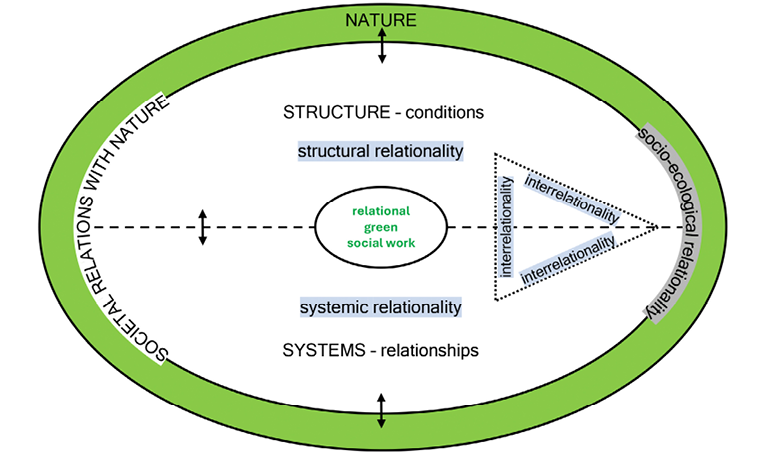
Fig. 1 The interrelationality of relational green social work
Green social work that sees itself as relational is based on interrelationality and therefore takes into account structural, systemic and socio-ecological relationality in its everyday practice, i.e. social conditions, social relationships and societal relations with nature in their interdependence. Relational green social work refers to several relations and takes place in several relations.
This fact naturally also applies to its sub-types and must be specified in each particular case. Four sub-types of relational green social work, each with corresponding practices, can be distinguished; hybrid forms are also conceivable:
- Social work in nature – uses nature uses natural resources to address social (or cultural) problems and potentials.
- Social environmental adaptation support – protects against nature supports individuals and communities when their lives (and coexistence) are exposed to natural hazards (in extreme cases disaster relief).
- Preventive green social work – protects nature supports individuals and communities in protecting natural resources and preventing impending socio-ecological problems.
- Political green social work – is committed to nature advocates for measures in the political arena that promise to realise fundamental socio-ecological values.
All four sub-types recognise the intrinsic value of nature. They reflect the duality of nature. They recognise both the enabling (1.) and restrictive (2.) aspects of nature, as well as the sometimes devastating environmental consequences of human activity — particularly the imperial mode of living — which, in view of planetary boundaries, must be prevented (3.) and effectively regulated (4.).
Dominelli (2012, p. 27) has developed a «Green Social Work Wheel of Knowledge for Action» with many components. Following Habermas’ (1984, p. 329) validity claims, relational green social work distinguishes between descriptive and explanatory knowledge (truth), evaluative knowledge (intersubjective: rightness, subjective: truthfulness) and action knowledge («truth-analogous»: effectiveness). Such knowledge of different kinds flows into iterative practice, i.e. into the sequence of (1) situation assessment, (2) situation analysis, (3) goal setting and (4) action planning, from which (5) intervention or prevention emerges, after which the sequence begins again. The goal setting is based on the situation assessment and the action planning on the situation analysis.
Dominelli’s approach does not express working principles very clearly. Green social work explicitly follows six working principles: systematicity, criticism, relationality, iteration, participation and transformation. Among these working principles, explicit relationality is the main difference from Dominelli, although the shared preference for community work naturally implies relationality. If the difference between the two approaches is to be recognisable in the name, it makes sense to translate «Grüne Soziale Arbeit» into «relational green social work» for the English-speaking world.
From a relational perspective, one metaphor is particularly valuable, especially in the context of community work: that of the bridge. Relational social work is essentially bridge building. The common prefix inter refers to the bridge that brings together different individuals — individuals who are structurally positioned differently, who are systemically active, and who are categorised in terms of time, space and society. Relevant differences must be taken into account in a differentiated manner:
- structure & system
- classes: interclass
- fields: intersectoral
- milieus: intercultural
- time & space
- time: intergenerational
- space: international
- social categories: intersectional.
Building social bridges bringing together people who would not normally come into contact with each other, across class, milieu and field boundaries, overcoming generational and national boundaries as well as those between different social categories: this means establishing contact between separate, and, in extreme cases, divided population groups and, first and foremost, entering into a dialogue in which everyone, especially the weaker members of society, can express themselves on an equal footing, and in which, in accordance with the ethics of advocacy, the (presumed) interests not only of those less able to express themselves but also of nature (Hogh, 2021) are taken into account. From a relational point of view, turning those affected into participants means turning the unconnected into connected individuals, inspired by the idea of social cohesion and a connection with nature.
Relational green social work pays attention to the quantity and quality of relationships. As far as the coordination of action is concerned, it is concerned with contacts within lived relationships that are characterised by validity claims and, as far as possible, no claims to power, and underpinned by feelings of appreciation; yet which, particularly in the political sphere and with regard to intersectional class relations, also ensure that the claims to power and participation of the powerless (the destitute and the disenfranchised) and the disadvantaged, for example through community organising. And relational green social work is simultaneously concerned with building another bridge, the one between humans and non-human nature. The bridge construction is becoming more complex. An interrelational spirit permeates the construction.
From an intersectoral perspective, the focus is on the interplay between the key roles and the tangential roles within each sector of society, as well as the interplay between key roles from different sectors. Relational green social work proposes a model of an environmental pentagon (Husi, 2024, p. 103), which refers to five key roles. These are financiers and suppliers in the economy, regulators in the state, interpreters in culture and carers in the community. They are counterbalanced by corresponding tangential roles, with both sides being mutually dependent on each other, which also results in a certain amount of power for both sides. The key roles played in various sectors must be considered in the context of their interplay, because the socio-ecological polycrisis stems not only from market and state failures, but also from cultural and community failures (Husi, 2022a, p. 303). In this respect, no single sector of society can be addressed in isolation when it comes to tackling the polycrisis, even though the economic sector is predominant in capitalist societies. If the global socio-ecological crisis is to be overcome, a differentiated socio-ecological accountability in the sense of making people responsible and holding them accountable is necessary.
According to the polluter pays principle, certain classes and milieus, as well as certain generations and nations, bear a special responsibility, while all sectors of society, but particularly the economy, are involved and roles with great decision-making powers have a special responsibility. One’s position in the social structure, in the circumstances, or more precisely, in the hierarchical, institutional and cultural structure of society, means different levels of responsibility for the consequences of the prevailing way of life, which can be understood as an imperial mode of living. Those who have many resources and, linked to this, represent certain values, interests, attitudes, etc., as well as occupying roles with great decision-making power, have a corresponding tendency to have a way of life that has serious consequences for nature and humanity. Relational green social work is aware of this fact and participates in corresponding multiple socio-ecological responsibilisation (Husi, 2025b, p. 218).
By now, it should have become clear how the theoretical foundations of social theory — in this case, primarily those of Bourdieu, Giddens and Habermas, as well as social and political ecology — help to shape Relational Green Social Work by providing it with a world view. If the crisis-ridden socio-ecological developments in society’s relationship with nature are to be transformed, relational green social work must address structures that themselves stem from structured social practice. In doing so, it encounters a chaotic jumble of relationships that offers little hope of success for seemingly simple solutions to the socio-ecological polycrisis.
Such a world view must be complemented by a set of values. In normative terms, this means that relational green social work must be guided, in social terms, not only by justice but also by cohesion as a fundamental value. Beyond the reference to society and the distinction between structure and practice/system, values relating to nature and the individual are no less important. Incidentally, it is apparent that the value of sustainability is not capable of representing all of these relevant references. The inaccuracies of the sustainability discourse are probably one of the reasons why humanity has not yet succeeded in turning the socio-ecological tide. The values of relational green social work are based on individual, social and environmental ethics and recognise the intrinsic value of the individual, society and nature.
In its contributions to socio-ecological transformation, relational green social work follows three guiding principles that are widespread in social environmentalism:
- think and feel globally, act locally
- think and feel long term, act now
- think and feel holistically, act specifically
The first guiding principle refers to space, the second to time and the third to holism.
Relational thinking offers guidance in this regard. From a relational perspective, the third guiding principle can be understood as follows: «think and feel relationally, act specifically in relation to social conditions and relationships and the societal relations with nature as a whole».
As the guiding principles make clear, not only relational thinking is required, but also relational feeling — compassion, empathy. And it is not only words that are needed, but deeds.
Last but not least: relational green social work relies not only on an academic foundation, such as the one described above, but also on its integration into training programmes, which is also linked to the development of an appropriate professional habitus. And this modern form of social work relies, above all, on dedicated professional social workers.
Bibliography
Bedeian, A. G. (2016). A note on the aphorism «there is nothing as practical as a good theory». Journal of Management History, 22(2), 236-242.http://dx.doi.org/10.1108/JMH-01-2016-0004
Bourdieu, P. (1985a). Delegation and Political Fetishism. Thesis Eleven, 6(10/11), pp. 56-70.
Bourdieu, P. (1985b). The Social Space and the Genesis of Groups. Theory & Society, 14(6), 723-744.
Bourdieu, P. (1990). In Other Words. Essays Towards a Reflexive Sociology. Polity Press.
Bourdieu, P. (1998). Practical Reason: On the Theory of Action. Stanford University Press.
Bourdieu, P. (2010). Distinction: A Social Critique of the Judgement of Taste. Routledge.
Bourdieu, P., & Wacquant, L. (1992). An Invitation to Reflexive Sociology. University of Chicago Press.
Brand, U., & Wissen, M. (2017). The imperial mode of living. In C. L. Spash (Ed.), Routledge Handbook of Ecological Economics: Nature and Society (pp. 152-161). Routledge.
Brand, U., & Wissen, M. (2021). The Imperial Mode of Living: Everyday Life and the Ecological Crisis of Capitalism. Verso.
Bryan, A., Hingley-Jones, H., & Ruch, G. (2016). Relationship-based practice revisited. Journal of Social Work Practice, 30(3), 229-233.
Burkitt, I. (2018). Relational Agency. In F. Dépelteau (Ed.), The Palgrave Handbook of Relational Sociology (pp. 523-538). Springer.
Dépelteau, F. (Ed.) (2018a). The Palgrave Handbook of Relational Sociology. Springer.
Dépelteau, F. (2018b). Relational Thinking in Sociology: Relevance, Concurrence and Dissonance. In F. Dépelteau (Ed.), The Palgrave Handbook of Relational Sociology (pp. 3-33). Springer.
Dominelli, L. (1997). Sociology for Social Work. Macmillan.
Dominelli, L. (2002). Anti-Oppressive Social Work Theory and Practice. Palgrave Macmillan.
Dominelli, L. (2009). Disaster Interventions: Immediate Relief or Long-Term Reconstruction. In L. Dominelli, Introducing Social Work (pp. 140-154). Polity Press.
Dominelli, L. (2012). Green social work: From environmental crises to environmental justice. Polity Press.
Dominelli, L. (2013). Environmental justice at the heart of social work practice: Greening the profession. Journal of International Social Welfare, 22(4), 431-439.
Dominelli, L. (2014). Learning from our past: climate change and disaster interventions in practice. In C. Noble, H. Strauss & B. Littlechild (Eds.), Global social work: Crossing borders, blurring boundaries (pp. 341-351). University Press.
Dominelli, L. (2015). Green Social Work. In J. D. Wright (Ed.), International Encyclopedia of the social and behavioural sciences (2nd ed.) (pp. 385-391). Elsevier.
Dominelli, L. (2018). Green social work in theory and practice. A new environmental paradigm for the profession. In L. Dominelli (Ed.), The Routledge Handbook of Green Social Work (pp. 9-20). Routledge.
Dominelli, L. (2019a). Green social work, political ecology and environmental justice. In St. A. Webb (Ed.), The Routledge Handbook of Critical Social Work (pp. 233-243). Routledge.
Dominelli, L. (2019b). Women and community action. Local and global perspectives (3rd edizione). Policy Press.
Donati, P. (2011). Relational Sociology. A new paradigm for the social sciences. Routledge.
Emirbayer, M. (1997). Manifesto for a Relational Sociology. The American Journal of Sociology, 103(2), 281-317.
Folgheraiter, F. (2004). Relational social work: Toward networking and societal practices. Jessica Kingsley.
Folgheraiter, F. (2017). The sociological and humanistic roots of Relational Social Work. Relational Social Work, 1(1), 4-11.
Folgheraiter, F., & Raineri, M. L. (2012). A critical analysis of the social work definition according to the relational paradigm. International Social Work, 55(4), 473-487.
Folgheraiter, F., & Ranieri, M. L. (2017). The principles and key ideas of Relational Social Work. Relational Social Work, 1(1), 12-18.
Folgheraiter, F., & Ranieri, M. L. (2023). The relational foundation of Social Work. Relational Social Work, 7(2), 2-21.
Fricker, M. (2007). Epistemic injustice: Power and the ethics of knowing. Oxford University Press.
Giddens, A. (1984). The Constitution of Society: Outline of the Theory of Structuration. Polity Press.
Giddens, A. (1993). New Rules of Sociological Method (2a ed.). Stanford Press.
Giddens, A. (2009). The Politics of Climate Change. Polity Press.
Görg, Ch. (2011). Societal Relationships with Nature: A Dialectical Approach to Environmental Politics. In A. Biro (Ed.), Critical Ecologies: The Frankfurt School and Temporary Environmental Crises (pp. 43-72). University of Toronto Press.
Granovetter, M. S. (1973). The Strength of Weak Ties. American Journal of Sociology, 78(6), 1360-1380.
Habermas, J. (1984). The Theory of Communicative Action. Reason and the Rationalisation of Society. Polity Press.
Habermas, J. (1987). The Theory of Communicative Action. The Critique of Functionalist Reason. Polity Press.
Haluza-DeLay, R. (2008). A Theory of Practice for Social Movements: Environmentalism and Ecological Habitus. Mobilisation: The International Quarterly, 13(2), 205-218.
Häußling, R. (2010). Relationale Soziologie. In Ch. Stegbauer & R. Häußling (Eds.), Handbuch Netzwerkforschung (pp. 63-87). VS Verlag.
Hogh, Ph. (2021). «Auch die Natur wartet auf die Revolution.» Ansätze einer advokatorischen Ethik der Natur in der Kritischen Theorie. Deutsche Zeitschrift für Philosophie, 69(5), 742-764.
Honneth, A. (1991). The Critique of Power. Reflective Stages in a Critical Social Theory. MIT.
Houston, St. (2019). Extending Bourdieu for critical social work. In St. A. Webb (Ed.), The Routledge Handbook of Critical Social Work (pp. 105-114). Taylor & Francis.
Husi, G. (2022a). Grüne Soziale Arbeit – eine sozialtheoretische Fundierung. Soziale Arbeit, 71(8/9), 300-309.
Husi, G (2022b). Was ist soziale Kohäsion? Eine sozialtheoretische Skizze. In F. Baier, St. Borrmann, J. M. Hefel & B. Thiessen (Eds.), Europäische Gesellschaft(en) zwischen Kohäsion und Spaltung. Rolle, Herausforderungen und Perspektiven Sozialer Arbeit (pp. 57-70). Barbara Budrich.
Husi, G. (2024). Frankfurter Soziale Ökologie, gesellschaftliche Naturverhältnisse und Grüne Soziale Arbeit. soziales_kapital, 17(29), 87-108.
Husi, G. (2025a). Soziale und Politische Ökologie aus Wien: Ihre Bedeutung für die Grüne Soziale Arbeit. soziales_kapital, 18(30), 91-110.
Husi, G. (2025b). Imperiale Lebensweise und Grüne Soziale Arbeit. soziales_kapital, 18(31), 209-230.
Kraus, B. (2019a). Relational constructivism and relational social work. In St. A. Webb (Ed.), The Routledge Handbook of Critical Social Work (pp. 93-104). Taylor & Francis.
Kraus, B. (2019b). Relationaler Konstruktivismus – Relationale Soziale Arbeit: Von der systemisch-konstruktivistischen Lebensweltorientierung zu einer relationalen Theorie der Sozialen Arbeit. Beltz Juventa.
Kraus, B. (2023). Relationale Soziale Arbeit. https://www.socialnet.de/lexikon/Relationale-Soziale-Arbeit
Lessenich, St. (2023). Doubling Down on Double Standards: The Politics of Solidarity in the Externalisation Society. Journal of Political Sociology, 1(1), 15-32.
Lienard, L. (2020). L’approche communautaire dans le travail social: une perspective européenne. Université de Lorraine. https://hal.univ-lorraine.fr/tel-03205727v1
Marx, K. (2007) [1971]. Elementos fundamentales para la critica de la economia politica. Siglo XXI Editores. https://vburgos.online/PDF/Marx_Grundrisse_Vol.-1.pdf
Marx, K. (2015) [1939-41]. Grundrisse. Foundations of the Critique of Political Economy (Rough Draft). MIA.
https://www.marxists.org/archive/marx/works/download/pdf/grundrisse.pdf
Marx, K. (2011) [1859]. Manuscrits de 1857-1858, dits « Grundrisse ». Éditions Sociales [2011].
Marx, K. (1983) [1859]. Grundrisse der Kritik der politischen Ökonomie. In K. Marx & F. Engels, Werke Band 42 (pp. 15-770). Dietz.
Mayo, M. (1994). Community Work. In Ch. Hanvey & T. Philpot (Eds.), Practising social work (pp. 67-79). Routledge.
Närhi, K., & Matthies, A.-L. (2016). Conceptual and Historical Analysis of Ecological Social Work. In J. McKinnon & M. Alston (Eds.), Ecological social work: toward sustainability (pp. 21-38). Palgrave Macmillan.
Panciroli, C. (2017). Relational social work at the community level. Relational Social Work, 1(2), 36-51.
Ramsay, S., & Boddy, J. (2017). Environmental Social Work: A Concept Analysis. British Journal of Social Work, 47(1), 68-86.
Reckwitz, A. (2003). Grundelemente einer Theorie sozialer Praktiken. Eine sozialtheoretische Perspektive. Zeitschrift für Soziologie, 32(4), 282-301.
Ritzer, G. (2008). Modern Sociological Theory (7th ed.). McGraw-Hill.
Ruch, G., Turney, D., & Ward, A. (2018). Relationship-based social work: Getting to the heart of practice (2nd ed.). Jessica Kingsley.
Vandenberghe, F. (2018). The Relation as Magical Operator: Overcoming the Divide Between Relational and Processual Sociology. In F. Dépelteau (Ed.), The Palgrave Handbook of Relational Sociology (pp. 35-57). Springer.
Vester, M., Oertzen, P. v., Geiling, H., Hermann, Th., & Müller, D. (2001). Soziale Milieus im gesellschaftlichen Strukturwandel. Zwischen Integration und Ausgrenzung. Suhrkamp.
Wandeler, B., & Armbruster Elatifi, U. (Eds.) (2017). Conceptualiser l’animation socioculturelle. Un agir professionnel en vue de la participation démocratique et de la cohésion sociale. Éditions ies.
Winter, K. (2019). Relational social work. In M. Payne & E. Reith Hall (Eds.), Routledge Handbook of Social Work Theory (pp. 1-10). Routledge.
Husi, G. (2026). Towards a Relational Green Social Work. Relational Social Work, 10(2), 133-154, doi: 10.14605/RSW1022607.

Relational Social Work is licensed under a Creative Commons Attribution-NonCommercial-NoDerivatives 4.0 International License